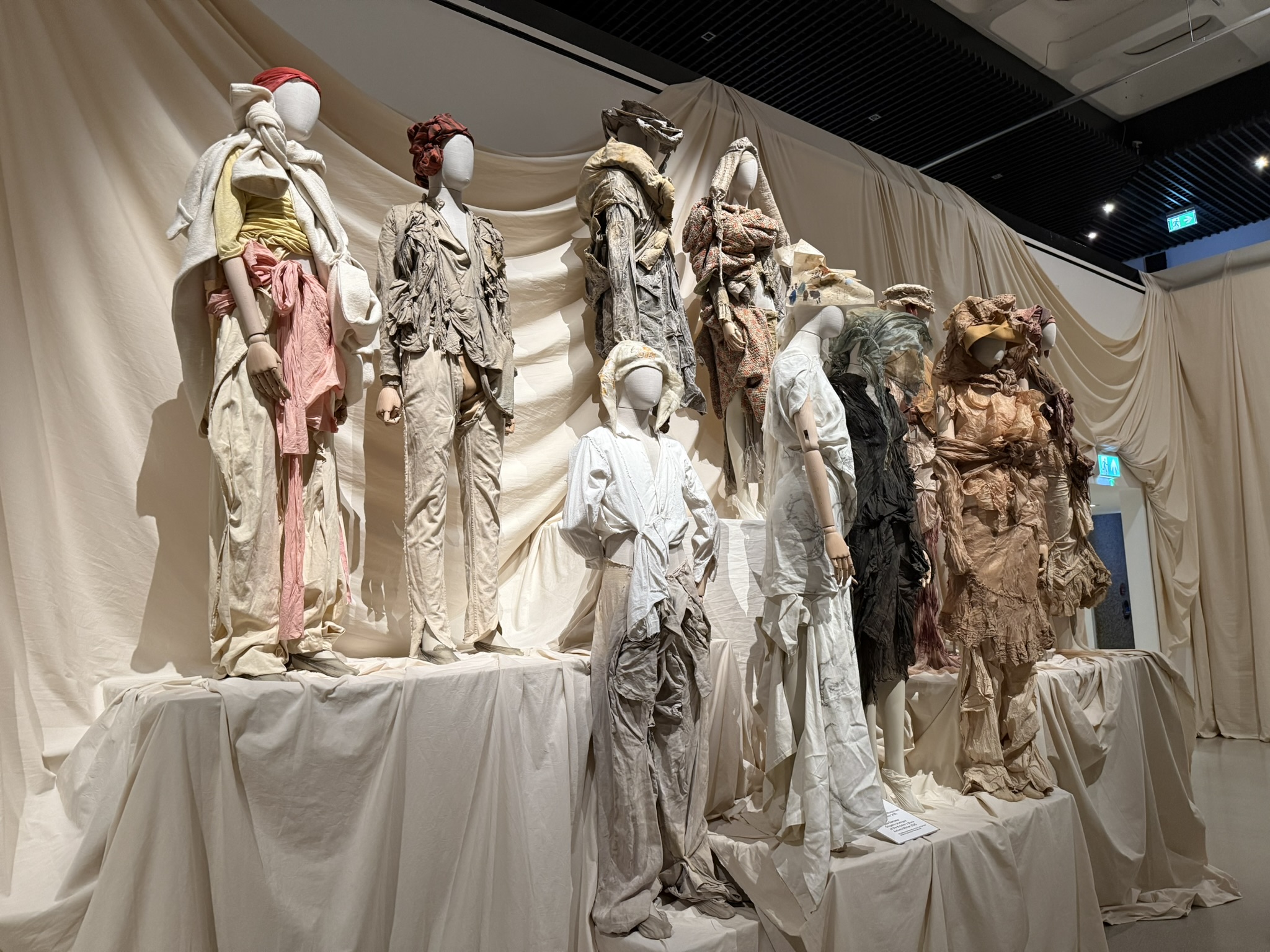
We are yet to meet someone who didn’t enjoy the Dirty Looks: Desire and Decay in Fashion, at the Barbican Art Gallery running until January 25, 2026. Its curation (by Karen Van Godtsenhoven) was slick and minimal with sustainably sourced mannequins and background fabrics which let the artworks and the exhibition text speak louder. Some of the most innovative minds in the craft of fashion are heralded for their subversive tendencies, political statements and poetic depths. The work was contextualised through literature and art movements and there was a pleasing balance of iconic household names with emerging talent. Fashion is often exhibited chronologically or around a specific designer but here the themes and categorisation were a perfect blend of surprising and totally logical. The word ‘Dirty’ is reframed many times over as you make your way through the different rooms and we wanted to highlight a few of the themes that really stayed with us.
DIRTY as in the ground, the mud and the molecules, the physical material that can transform and recolour.
Hussein Chalayans ‘Future Archaeology’ (a term coined for the exhibition) starts off the show, displaying his buried then exhumed garments carrying the traces of the ground. A dress coated with copper filings was buried near the Thames and forever oxidised green. The metaphor of ‘archaeological process’ makes one wonder what future generations might unearth and what stories our clothes are going to tell.

DIRTY as primordial, as rural, as our evolutionary past.
‘Nostalgia of Mud’ was a term used originally in the mid 19th century to describe how the industrialised societies longing to associate themselves ‘with the rural and rustic or what modernity and colonialism had labelled as primitive’ (from the exhibition blurb) This term was then reappropriated by Malcolm McLaren and Vivienne Westwood for their 1982 Autumn/Winter collection. Their work, and others exhibited in the same room, reference aesthetic traits from history, speaking to an anarcho-primitivist trend in designers’ work, a philosophy that critiques civilisation and advocates for a return to hunter-gatherer ways of life.


DIRTY as rebellion, as romanticism, as being part of the counterculture.
Lived in clothing has long since been a symbol of radicalism and creativity. Real or fake dirt has been a badge of honour for the Surrealists, the Beats, hippies and the Punks. Grunge and other more recent fashion trends have mined these histories and movements, knowingly or not, resulting in direct and seemingly permanent descendants like ripped denim. Degraded textiles are culturally dependent, as they symbolise an alignment with a particular lifestyle, movement or politics, yet designers have always been causing rifts in the fabric of high fashion, shocking the establishment. In the 80’s it was Rei Kawakubo, today it’s John Galliano.
DIRTY as shame, as stains, as taboo.
Designers have been reclaiming these accidental blemishes through purposeful and decorative means. Once seen as a failure to uphold standards of cleanliness, those marks made through life experience and creative endeavours are being memorialised in fabric and beading. ‘Stains as Ornament’ and ‘Leaky Bodies’ are two rooms showcasing designers who unravel concepts of shame, abject bodily fluids, purity and taboo through the lens of feminisms and popular culture. DI PETSA Spring/Summer 2025 collection ‘My Body is a Labyrinth’ feels like the culminating work, reclaiming the stain.


DIRTY as waste, as destruction, as oppression.
Mass production and an astonishing amount of waste within the industry are one of the less surprising interpretations of the theme. The industry is corrupted from the mechanisms of capitalism in the global north, creating ‘sacrifice zones’ in countries such as Ghana, India and Chile, their environments permanently altered by consumer trash. Born from the ashes are designers working with waste materials, upcycling and innovating and creating fashion that is inherently political. Within their work is humour and satire, making sense of painful global narratives and cultural scars. TRASHY Clothing, Ahluwalia and Miguel Androver are some of our favourites.


‘Dirty’ is explored in many more ways through amazing creatives such as Paolo Carzana, Alice Potts, IAMSIGO, Shelly Fox and Robert Wun, some trailblazing and others powerfully referential. In this exhibition fashion is celebrated as a high art, with references to literature and philosophy, as well as for the masses, looking to popular culture and grass roots movements. To top it all off, Colechi’s very own YKWU (You can Knit With Us) Club features in the Dirty Looks catalogue. The show was an all rounder, and we cannot recommend it enough.